
Handrail Length Estimator
Handrail Length Estimator
Calculate the total handrail length needed for your staircase, including returns and extensions. Supports both metric (meters/cm) and imperial (feet/inches) units – essential for safe and code-compliant stairs worldwide.
Handrail Length Estimator: Calculate Accurate Stair Railing Lengths Effortlessly
When it comes to installing a safe and code-compliant staircase, one detail often overlooked is the precise length of the handrail. Too short, and it compromises safety; too long, and it adds unnecessary cost and waste. The Handrail Length Estimator is designed to solve this problem, giving builders, designers, and DIY enthusiasts an easy way to calculate the total handrail length, including returns, extensions, and extra material for cuts.
Whether you’re renovating a home, installing a custom staircase, or planning commercial construction, knowing exactly how much handrail you need is critical. With our tool, you can confidently plan, buy materials efficiently, and ensure your staircase meets local safety regulations.
Why Handrail Length Matters
A properly measured handrail does more than guide someone up or down stairs. It impacts:
-
Safety: Correct height and length prevent falls and provide stable support.
-
Compliance: Most building codes mandate minimum and maximum handrail lengths and extensions.
-
Cost-efficiency: Avoid purchasing excess materials or cutting multiple pieces unnecessarily.
-
Aesthetic appeal: Smooth transitions, returns, and continuous lengths improve the staircase’s appearance.
Imagine installing a staircase without precise handrail measurements—your railing could end abruptly, leaving gaps, or require awkward joints. The Handrail Length Estimator prevents this scenario.
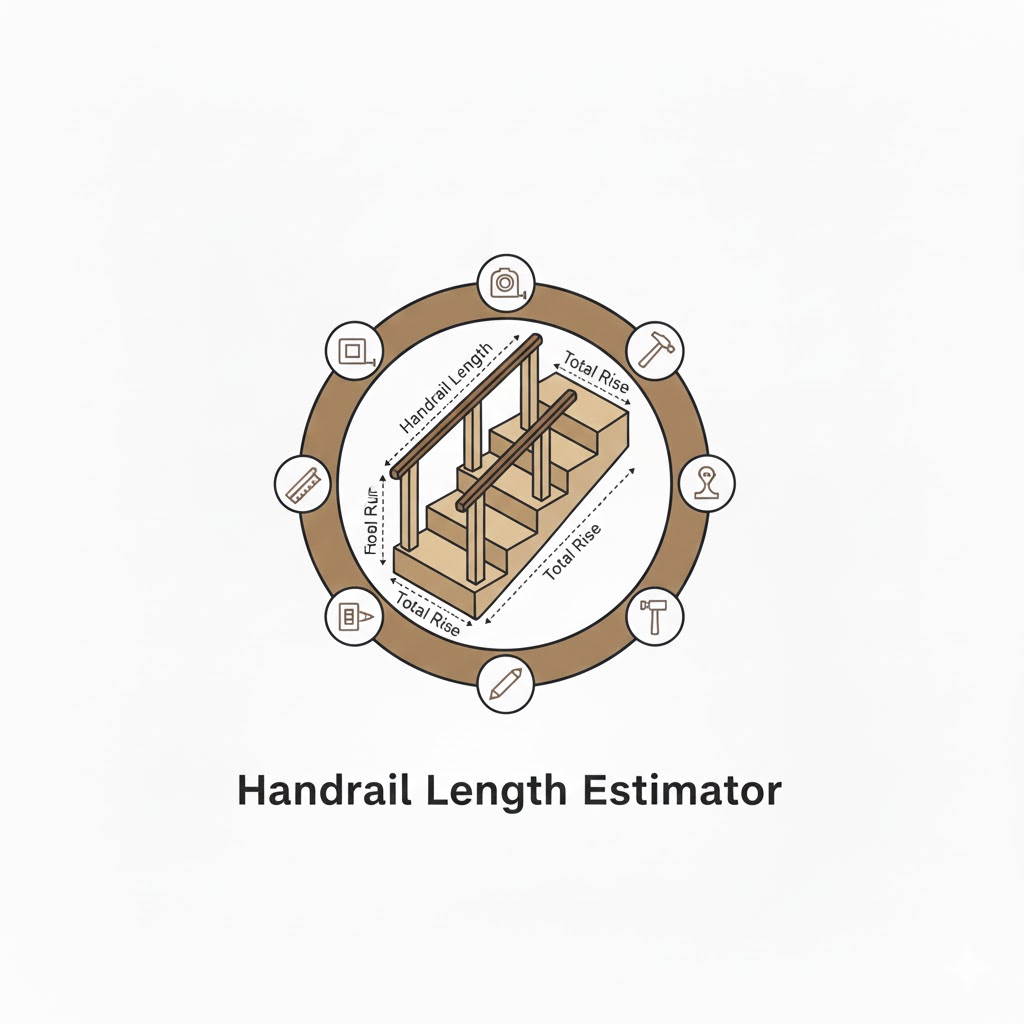
How the Handrail Length Estimator Works
The tool is built to be intuitive, supporting both metric (meters & cm) and imperial (feet & inches) units. Here’s a step-by-step explanation:
1. Inputs You Provide
-
Stair Diagonal Length (Stringer Length): The measurement along the slope of the staircase.
-
Bottom Horizontal Extension: Distance beyond the first stair nosing. Typically recommended at 300–400 mm (12–16 in).
-
Top Horizontal Extension: Extension beyond the top stair nosing.
-
Wall Return Length: Optional return length at each end, improving safety and finishing.
-
Number of Returns: Choose 0, 1, or 2 depending on your design.
-
Extra for Waste & Cuts (%): Adds material for mistakes or joints. Usually 10–15%.
2. Calculation Logic
The total handrail length is calculated as:
For example, if your staircase has a diagonal of 4.5 m, 0.3 m top and bottom extensions, 0.15 m returns on both ends, and 10% extra, the calculation is:
This simple formula ensures accuracy while considering all critical elements of a safe and compliant handrail.
Step-by-Step Examples
Example 1: Standard Home Staircase (Metric)
-
Stair diagonal: 3.6 m
-
Bottom extension: 0.3 m
-
Top extension: 0.3 m
-
Wall returns: 0.15 m each, 2 returns
-
Extra: 10%
Calculation:3.6 + 0.3 + 0.3 + (0.15 × 2) = 4.5 m
With extra: 4.5 × 1.10 = 4.95 m
Result: You’ll need approximately 4.95 meters of handrail.
Example 2: Loft Staircase (Imperial)
-
Stair diagonal: 14 ft
-
Extensions: 1 ft each
-
Wall returns: 6 in each, 2 returns
-
Extra: 12%
Calculation in feet:14 + 1 + 1 + (0.5 × 2) = 17 ft
With extra: 17 × 1.12 ≈ 19.04 ft
Result: Purchase just over 19 feet of railing for safe installation.
Example 3: Single-Return Open Stair
-
Stair diagonal: 2.8 m
-
Extensions: 0.25 m each
-
Wall returns: 0.1 m
-
Number of returns: 1
-
Extra: 10%
Calculation:2.8 + 0.25 + 0.25 + (0.1 × 1) = 3.4 m
With extra: 3.4 × 1.10 = 3.74 m
Result: Handrail needed: 3.74 meters, perfect for open stair layouts.
Practical Tips for Using the Handrail Length Estimator
-
Always measure the stringer accurately: The diagonal is the foundation of your calculation.
-
Follow local building codes: Top and bottom extensions and return designs often have legal minimums.
-
Include waste: Cuts, joins, and adjustments require extra material—usually 10–15%.
-
Check your rail height: Typically 900–1000 mm (34–38 inches) above the nosing line.
-
Continuous lengths are ideal: Avoid multiple joints for safety and aesthetics.
Related Tools to Simplify Stair Planning
-
Baluster Spacing Calculator – Determine the number of balusters needed for your staircase.
-
Spiral Staircase Planner – Plan custom spiral stair layouts.
-
Closet Shelving Quantity Tool – Useful for optimizing storage in stair-adjacent spaces.
These tools complement the Handrail Length Estimator, making full staircase and railing projects more efficient.
FAQs
1. Can I use this tool for curved or spiral stairs?
Yes, but for curved stairs, consider measuring along the actual path the handrail will follow. Spiral staircases often require specialized planning tools like our Spiral Staircase Planner.
2. How much extra should I add for waste and cuts?
Typically 10–15% extra is sufficient for trimming, mistakes, and joining pieces. For complex staircases, consider slightly higher percentages.
3. Does the tool comply with building codes?
The calculator helps you plan safe lengths, but always verify top/bottom extensions, returns, and height against local building codes before purchasing materials.
Conclusion
The Handrail Length Estimator is more than just a calculator—it’s a practical planning assistant for anyone installing or designing a staircase. By accurately factoring in diagonal length, extensions, returns, and extra material, it saves time, reduces waste, and ensures safety.
Whether you’re a builder, designer, or DIY enthusiast, this tool makes handrail planning precise and hassle-free. Try different inputs to explore various scenarios and ensure your staircase meets both practical and code requirements.
For complete staircase planning, pair this with our Baluster Spacing Calculator and Spiral Staircase Planner to create a seamless, safe, and visually appealing staircase project.