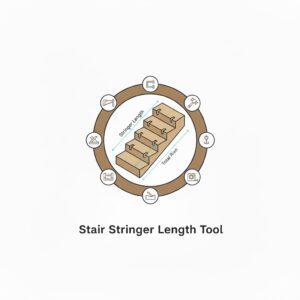
Basement Stairs Material Calculator
Basement Stairs Material Calculator
Estimate lumber and materials needed for building basement stairs (stringers, treads, risers). Supports both metric (meters/cm) and imperial (feet/inches) units – perfect for DIY or contractor planning worldwide.
Basement Stairs Material Calculator: Your Complete Guide to Planning Stair Materials
Building a basement staircase can be one of the most challenging home improvement projects. Whether you’re finishing a new basement or renovating an older one, accurately estimating the lumber and materials needed is crucial. That’s where the Basement Stairs Material Calculator becomes indispensable. This tool allows you to quickly determine the number of stringers, treads, and risers needed, helping you save time, money, and potential frustration during construction.
Imagine starting a DIY basement project only to realize mid-build that your treads are too short or your stringers are inadequate. A miscalculation like this can set back your project by days. With this calculator, you can plan precisely and ensure your stairs are safe, sturdy, and code-compliant.
Why Estimating Basement Stair Materials Matters
Basement stairs aren’t just functional—they’re a key safety element in your home. Improper measurements can lead to:
-
Uneven treads or risers, increasing fall risk.
-
Wasted lumber, adding unnecessary cost.
-
Structural weaknesses in stringers if material lengths are insufficient.
By using a basement stair lumber estimator, you can avoid these pitfalls. The tool gives you confidence in your planning, whether you’re a DIY enthusiast or a professional contractor.

How the Basement Stairs Material Calculator Works
The tool is designed to provide quick, accurate material estimates based on your staircase dimensions. Here’s a breakdown of its functionality:
1. Inputs You Provide
-
Unit System: Metric (meters/cm) or Imperial (feet/inches)
-
Total Floor-to-Floor Height: Distance from basement floor to upper level
-
Total Horizontal Run: Staircase horizontal length
-
Stair Width: Width of each tread
-
Number of Stringers: Typically 3–5, depending on stair width
-
Stringer Depth / Stock Size: Usually 2×12 lumber (approx. 286mm)
-
Tread Thickness: Standard 38mm (1.5″) boards
-
Extra for Waste (%): Optional buffer for cuts and errors
2. Calculations Performed
Once the inputs are entered, the calculator performs several key computations:
-
Number of Risers and Treads:
UsingnumRisers = ceil(totalHeight / 0.18), where 0.18m (~7″) is a typical riser height. Treads are calculated asnumTreads = numRisers - 1. -
Stringer Length:
Using the Pythagorean theorem,stringerLength = sqrt(totalHeight² + totalRun²). -
Total Stringer Material:
totalStringerLength = stringerLength * numStringers * (1 + extraPercent/100) -
Tread Requirements:
totalTreads = numTreadswith width considered for full coverage. -
Recommended Stock Length:
Matches the calculated stringer length to common lumber sizes for practical ordering.
3. Outputs You Receive
The results are presented in an easy-to-read format, highlighting:
-
Total height and run of the staircase
-
Number of risers and treads
-
Individual stringer length
-
Total stringer material including waste
-
Recommended stock lengths
-
Estimated treads required
These calculations align precisely with the real-world lumber you’ll purchase and cut, making project planning accurate and stress-free.
Step-by-Step Examples
Example 1: Standard Metric Basement
-
Height: 2.8 m
-
Run: 3.5 m
-
Width: 1.0 m
-
Stringers: 4
Calculation Highlights:
-
Risers =
ceil(2.8 / 0.18) = 16 -
Treads = 16 – 1 = 15
-
Stringer length =
sqrt(2.8² + 3.5²) ≈ 4.5 m -
Total stringer material = 4.5 × 4 × 1.15 ≈ 20.7 m
Result: Purchase 4 stringers at ~4.5 m each and 15 treads at 1 m wide.
Example 2: Imperial Basement Renovation
-
Height: 9 ft
-
Run: 11.5 ft
-
Width: 3.3 ft
-
Stringers: 5
Calculation Highlights:
-
Risers =
ceil(9 / 0.583) ≈ 16(7″ risers) -
Treads = 15
-
Stringer length =
sqrt(9² + 11.5²) ≈ 14.5 ft -
Total stringer material = 14.5 × 5 × 1.15 ≈ 83.4 ft
Result: 5 stringers, each 14.5 ft long, 15 treads of 3.3 ft width.
Example 3: Wide Basement Staircase
-
Height: 3 m
-
Run: 4 m
-
Width: 1.5 m
-
Stringers: 5
Key Consideration: Wider stairs need more stringers for stability. Using the tool ensures all treads are level and supported.
Practical Tips for Safe and Efficient Stair Construction
-
Use pressure-treated lumber for basements to prevent moisture damage.
-
Add 1 extra stringer for stairs wider than 1 m (~3 ft).
-
Always include 10–15% extra material to cover errors or off-cuts.
-
Use a layout square to mark stringers accurately.
-
Confirm local building codes for maximum riser height and minimum tread depth.
Related Tools for Home Improvement Planning
-
Bookshelf Lumber Estimator – Plan shelving boards precisely.
-
Closet Shelving Quantity Tool – Calculate panels and rails for your custom closets.
-
Explore more home improvement calculators for efficient DIY planning.
FAQs
1. Can this tool handle irregular stair shapes?
The calculator is designed for straight stairs. For L-shaped or spiral stairs, consult a stair specialist or adjust measurements manually.
2. What if I want non-standard riser heights?
You can input your preferred total height and the tool will recalculate the number of risers and treads. Always check compliance with local codes.
3. Does it account for wood shrinkage or warping?
The tool doesn’t automatically include material shrinkage. Add a small buffer (5–10%) beyond the recommended “extra for waste” if using untreated or natural lumber.
Conclusion
The Basement Stairs Material Calculator is a must-have for anyone planning a safe and efficient staircase. By inputting your dimensions, you receive precise guidance on stringers, treads, and risers, ensuring your project stays on time and within budget. Whether you’re a DIYer or a professional, using this tool saves you from guesswork and potential mistakes.
Test different dimensions, widths, and lumber options to see how your staircase plans adjust in real time. For more accurate home improvement planning, explore related tools like the Bookshelf Lumber Estimator or Closet Shelving Quantity Tool.