Car Restoration Paint Calculator
Car Restoration Paint Calculator
Estimate paint quantity for full car respray or panel work. Includes primer, base coat, clear coat, and waste factor for automotive painting.
Car Restoration Paint Calculator: Accurately Estimate Your Vehicle’s Paint Needs
Restoring a car to its original glory—or giving it a fresh new look—can be one of the most satisfying projects for any car enthusiast. But one of the first questions that comes up is: how much paint do I actually need? This is where a Car Restoration Paint Calculator becomes an essential tool. Whether you’re a professional auto painter or a DIY enthusiast, knowing the exact paint quantities prevents costly mistakes, wasted materials, and uneven finishes.
In this article, we’ll break down the practical steps, formulas, and real-life tips to help you accurately estimate paint for full resprays, partial panels, or even a single panel. We’ll also cover primer, base coat, clear coat, and how to factor in color complexity and application methods.
Why Using a Car Paint Calculator Matters
Imagine this scenario: you’re about to respray your compact car, but you buy too little paint. Halfway through, the color is finished, forcing you to mix more batches that might slightly differ in shade. Or worse, you overspend on paint you don’t need.
A Car Paint Calculator solves this problem by:
-
Calculating surface area based on vehicle size and scope.
-
Estimating primer, base coat, and clear coat requirements accurately.
-
Accounting for application waste and special color types like metallic or candy finishes.
-
Providing actionable tips to reduce overspray and improve finish quality.
This makes your restoration project smoother, cheaper, and more professional-looking.
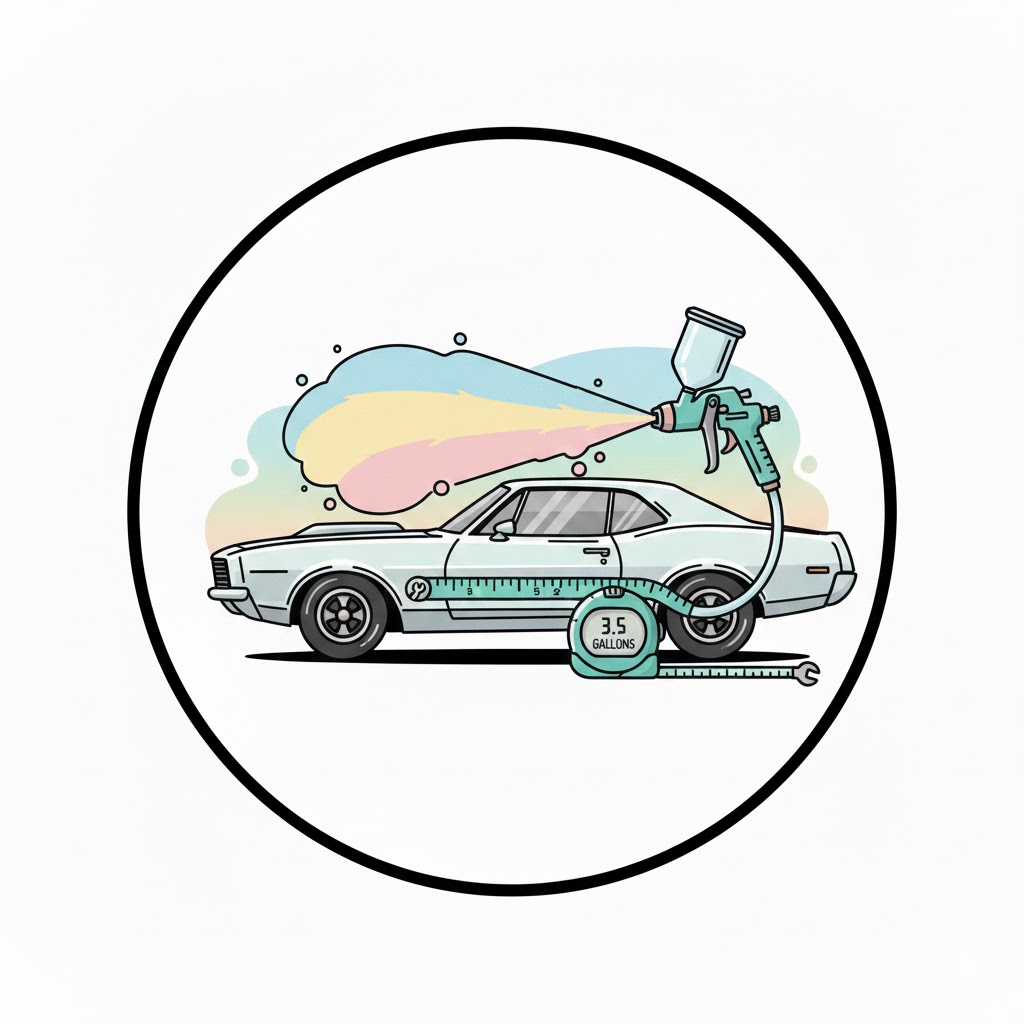
How the Car Restoration Paint Calculator Works
The calculator uses a combination of vehicle size, paint scope, paint system, color type, and application method to give precise results. Here’s a breakdown:
1. Vehicle Size
The tool considers four categories:
-
Small cars: Mini, Fiat 500
-
Compact cars: Golf, Civic
-
Midsize cars: Camry, Accord
-
Large SUV/Trucks
Each category has an estimated surface area (in m²), which forms the base for paint calculations:
2. Paint Scope
-
Full respray: Entire exterior → multiplier = 1.0
-
Partial respray: Selected panels (hood, fenders, doors) → multiplier = 0.5
-
Single panel: Only one panel → multiplier = 0.15
Formula for area to paint:
3. Paint System
Different paint systems cover the surface differently:
| System | Components | Coverage per m² (liters) |
|---|---|---|
| 2K Urethane | Primer + Base + Clear | Primer: 0.20, Base: 0.20, Clear: 0.30 |
| Single-stage | Color + Gloss | Base: 0.25 |
| Base/Clear | Base + Clear only | Base: 0.25, Clear: 0.30 |
4. Color Type
Color complexity affects the amount of paint needed:
-
Solid: factor = 1.0
-
Metallic/Pearl: factor = 1.3
-
Candy/Tri-coat: factor = 1.8
Formula:
5. Application Method
The tool accounts for waste factor depending on method:
-
Spray gun: factor = 1.5
-
Aerosol cans: factor = 2.0
Formula for total paint per coat:
Step-by-Step Example
Let’s calculate paint for a compact car, partial respray of metallic paint, using a 2K urethane system applied with a spray gun.
-
Base Area = 12 m² (compact car)
-
Scope multiplier = 0.5 →
12 × 0.5 = 6 m² -
Primer =
0.20 × 6 × 1.5 = 1.8 L→ round to 2 L -
Base coat =
0.20 × 6 × 1.3 × 1.5 = 2.34 L→ round to 2.5 L -
Clear coat =
0.30 × 6 × 1.5 × 1.2 = 3.24 L→ round to 3.5 L -
Total paint =
2 + 2.5 + 3.5 = 8 L
Result: You need 8 liters in total for this specific scenario.
Practical Tips for Car Painting
-
Buy slightly more paint than calculated: Mixing errors and touch-ups happen.
-
Use metallic/pearl colors carefully: They require more base coat and consistent technique.
-
Prep properly: Sanding, masking, and cleaning surfaces make up 80% of a perfect finish.
-
Safety first: 2K paints contain isocyanates—use a respirator and gloves.
-
Allow curing time: Don’t rush wet sanding or polishing; it affects the final gloss.
Real-Life Scenarios
-
DIY Enthusiast: A Fiat 500 owner wants to repaint a hood in solid red. Using a Car Paint Calculator, they find that just 1 liter of base coat plus primer and clear is enough—avoiding unnecessary expenses.
-
Professional Body Shop: Painting a midsize SUV with metallic finish. Accurate calculations prevent over-ordering and reduce leftover paint by nearly 30% per job.
-
Collector Car Restoration: Restoring a classic vehicle with a candy finish. Calculator estimates higher base requirements, helping the shop plan labor and costs effectively.
FAQs About Car Restoration Paint Calculator
Q1: Can I use the calculator for motorbikes or trucks?
A1: Yes, but adjust the surface area manually. Small motorbikes = ~6 m²; large trucks = ~20 m².
Q2: Does it include multiple coats?
A2: Yes, the formulas factor in 2–3 coats for base and clear layers automatically.
Q3: Can I rely on it for DIY aerosol sprays?
A3: Absolutely, but waste factor is higher, so expect slightly more paint usage than professional spray guns.
Conclusion
A Car Restoration Paint Calculator is an indispensable tool for anyone tackling vehicle painting. By considering vehicle size, scope, paint system, color type, and application method, it helps save money, ensures color consistency, and makes your project efficient.
Start using the calculator for your next restoration and see how accurate paint estimation can simplify your work. For related tools, check: