Ceramic Floor Tile Quantity Calculator
Ceramic Floor Tile Quantity Calculator
Calculate how many ceramic tiles you need for your floor. Includes waste factor, grout spacing, and supports metric/imperial units.
Ceramic Floor Tile Quantity Calculator: How to Accurately Estimate Tiles for Any Room
When planning a home renovation or a simple floor upgrade, one of the first questions you might ask is: “How many tiles do I really need?” That’s where a Ceramic Floor Tile Quantity Calculator becomes your best friend. Whether you’re a DIY enthusiast or a professional contractor, calculating tile requirements accurately saves time, money, and frustration—no more running back to the store mid-project or ending up with leftover tiles that gather dust.
In this guide, we’ll walk you through everything you need to know about estimating ceramic tiles for your floor, including practical examples, easy-to-use formulas, and professional tips for a flawless installation.
Why You Need a Ceramic Floor Tile Estimator
Estimating tile quantities isn’t just about covering the floor area—it’s about accounting for grout spaces, cuts, and extra tiles for wastage.
-
Avoid overspending: Buying too many tiles increases costs unnecessarily.
-
Prevent shortages: Running out of tiles mid-project can cause delays and mismatch issues.
-
Plan for repairs: Extra tiles come in handy if some get damaged or chipped later.
A Floor Ceramic Tile Calculator does the heavy lifting by taking your room dimensions, tile size, grout width, and wastage percentage into account, giving you a precise recommendation for how many tiles to purchase.
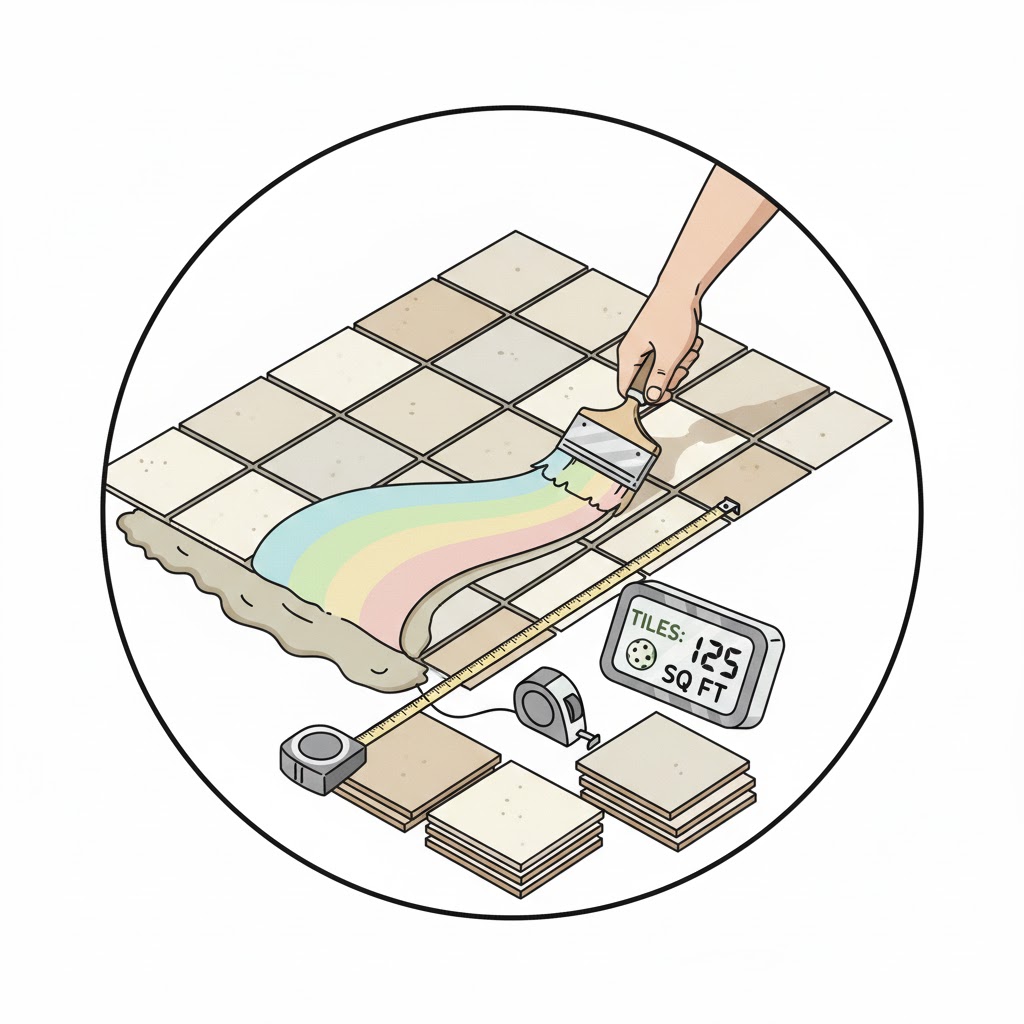
How the Ceramic Tile Coverage Calculator Works
At its core, the calculator uses simple geometry and practical adjustments. Here’s the step-by-step approach:
-
Measure the Room
Measure the length (L) and width (W) of the room. For irregular spaces, divide into rectangles and calculate each separately. -
Measure the Tile Size
Note the length (l) and width (w) of the ceramic tile you plan to use. -
Consider Grout Spacing
If grout joints aregmm wide, add this to each tile dimension in calculations. -
Add Wastage
Depending on the pattern and cuts, include a wastage factor (p), usually 5-15%.
Basic Formula
The number of tiles along the room’s length and width is:
Total tiles needed without wastage:
Recommended tiles including wastage:
Practical Examples
Example 1: Simple Rectangle Room
-
Room: 5m x 4m
-
Tile: 0.6m x 0.3m
-
Grout: 3mm (0.003m)
-
Wastage: 10%
So, 139 tiles should be purchased to cover the room comfortably.
Example 2: Irregular Room with Cutouts
-
Room: L-shaped, total effective area: 12m²
-
Tile: 0.5m x 0.5m
-
Grout: 5mm (0.005m)
-
Wastage: 15%
This approach ensures that even with corners and cutouts, you have enough tiles.
Example 3: Diagonal Tile Layout
Diagonal patterns create more cuts, so higher wastage (around 15%) is recommended. If your room is 6m x 5m and tile 0.6m x 0.6m:
This accounts for extra tiles lost during angled cuts.
Tips for Accurate Estimation
-
Always measure twice: Room dimensions should be accurate.
-
Check tile batch numbers: Buying from a single batch ensures color consistency.
-
Dry lay tiles first: Helps visualize cuts and layout.
-
Use spacers for grout: Keeps lines straight and spacing consistent.
-
Consider future repairs: Keep 5-10% extra tiles in storage.
Related Tools for Floor Planning
-
Explore more: Home Improvement Calculators | Tile Calculators
These tools complement the Ceramic Floor Tile Calculator, especially if you are considering mixed materials or different room types.
FAQs About Ceramic Floor Tile Quantity Calculator
1. How much extra tile should I buy for wastage?
-
For straight layouts with minimal cuts, 5-10% extra is sufficient. For diagonal or patterned layouts, aim for 10-15% extra.
2. Can I use this calculator for irregular-shaped rooms?
-
Yes! Break your space into rectangles, calculate each separately, and sum the totals.
3. Does grout size affect tile calculation?
-
Absolutely. Grout spacing increases effective tile dimensions. Always include
grout widthin your calculations to avoid shortages.
Conclusion
The Ceramic Floor Tile Quantity Calculator is a must-have tool for anyone planning a floor renovation. By accounting for room dimensions, tile size, grout spacing, and wastage, you can purchase exactly the right number of tiles, save money, and achieve a professional-looking floor.
Start using the calculator today to plan your project efficiently, avoid last-minute store runs, and ensure your flooring is flawless. Don’t forget to check related tools like the Porcelain Tile Estimator for complete home improvement planning.