Inground Pool Excavation Calculator
Inground Pool Excavation Calculator
Estimate excavated volume, loose dirt, and rough excavation + disposal cost for your inground pool (rough planning only – get local quotes!).
Inground Pool Excavation Calculator: Estimate Volume, Dirt, and Costs with Ease
Building an inground pool is an exciting way to enhance your backyard—but it comes with challenges, especially estimating excavation volume and costs. Many homeowners struggle to determine how much soil needs to be removed, how loose dirt affects disposal, and what price range to expect from local contractors. That’s where the Inground Pool Excavation Calculator comes in: a practical tool that takes the guesswork out of planning your pool site and gives you accurate, data-driven estimates.
Whether you’re planning a rectangular lap pool or a kidney-shaped backyard oasis, understanding excavation volume and cost is essential for budgeting, project planning, and avoiding unexpected expenses.
Why You Need a Pool Excavation Volume Calculator
Excavating a pool site isn’t as simple as digging a hole. Several factors impact the effort, cost, and materials involved:
-
Pool dimensions: Longer, deeper, or wider pools naturally require more excavation.
-
Shape adjustments: Freeform or L-shaped pools involve irregular cuts, increasing soil volume.
-
Soil type and site access: Rocky soil, poor access, or hauling challenges can drive costs up.
-
Local labor rates: Excavation pricing varies widely based on your region and contractor availability.
By using an inground pool digging estimator, you can calculate:
-
Pool water volume (solid volume in cubic yards)
-
Loose soil volume after excavation
-
Rough excavation and disposal cost, including potential extras like rock removal or hauling fees
This empowers homeowners to plan budgets realistically and communicate effectively with contractors.
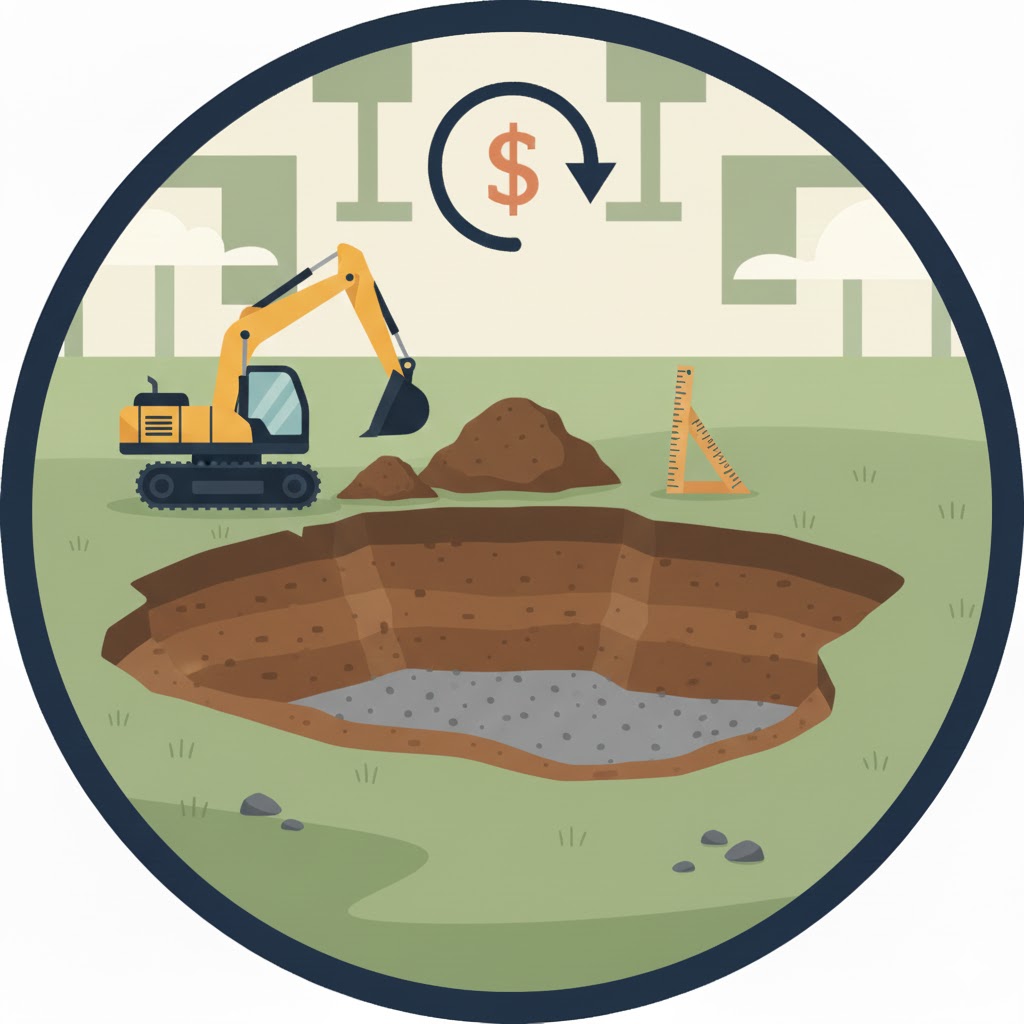
How the Inground Pool Excavation Calculator Works
The tool simplifies complex excavation math into a few clear steps:
Step 1: Input Pool Dimensions
Enter the length, width, and average depth of your pool. These values are used to calculate the solid pool volume in cubic feet:
For example, a 32 ft × 16 ft × 5.5 ft rectangular pool:
Step 2: Select Pool Shape
Shapes affect excavation volume due to irregular cuts:
-
Rectangle / Lap Pool: No adjustment
-
Kidney / Freeform: Multiply by 0.75
-
L-Shape: Multiply by 0.88
-
Irregular / Custom: Multiply by 0.82
Using the previous example for a kidney pool:
Step 3: Convert to Cubic Yards
Excavation contractors often measure in cubic yards:
Step 4: Account for Loose Dirt (Swell Factor)
Excavated soil expands by about 28% (called the swell factor), increasing the volume that needs hauling or disposal:
Step 5: Estimate Cost
Base cost per cubic yard varies by region:
-
Low-cost: ~$12/yd³
-
Average: ~$22/yd³
-
High-cost/rocky: ~$42/yd³
Extra factors (haul-away, rock, access difficulty, deeper end) are added as flat fees. Using the example:
The calculator automatically performs these calculations and outputs pool water volume, loose dirt volume, and total estimated cost.
Practical Examples
Example 1: Standard Rectangle Pool
-
30 ft × 15 ft × 5 ft
-
Rectangle shape, average-cost area, haul-away extra
Calculation:
Example 2: Kidney Pool
-
32 ft × 16 ft × 5.5 ft
-
Kidney shape, medium-cost region, no extras
Calculation (as shown above):
Example 3: L-Shaped Pool with Rocky Soil
-
28 ft × 18 ft × 6 ft
-
L-shape, high-cost region, rock + access issues
Calculation:
These examples show how shape, depth, and soil conditions drastically impact excavation volume and cost, illustrating why using a pool site preparation planner is essential.
Tips for Using the Calculator Effectively
-
Test multiple scenarios – Change depth, shape, and extras to understand cost ranges.
-
Check local rates – Use real contractor quotes to refine your estimates.
-
Plan for contingencies – Include 20–40% buffer for unexpected site conditions.
-
Use for budgeting – Helps determine whether your pool design is feasible financially.
Related Tools for Home Improvement Planning
-
Sauna Lumber & Bench Calculator – plan materials for backyard projects.
-
Crochet Hook Size Chart Tool – precise sizing for DIY crafting projects.
-
Home Improvement Calculators – explore related tools for budgeting and planning.
FAQs
Q1: Can I use this calculator for irregularly shaped pools?
Yes! Select “Irregular / Custom” in the shape menu. The tool applies a shape factor (~0.82) to approximate excavation volume.
Q2: How accurate are the cost estimates?
The calculator provides rough planning estimates. Real costs depend on permits, soil conditions, haul distances, and contractor rates. Expect ±20–40% variation.
Q3: Why is loose dirt volume higher than pool volume?
Excavated soil expands when removed (called swell), increasing the volume you need to haul or store.
Conclusion
The Inground Pool Excavation Calculator is more than a simple math tool—it’s a practical guide for homeowners, contractors, and DIY planners. By inputting your pool’s dimensions, shape, and site conditions, you can instantly see excavation volume, loose dirt requirements, and estimated costs.
Experiment with different shapes, depths, and extras to plan efficiently and avoid surprises. For comprehensive home improvement planning, explore related calculators and see how accurate planning transforms your backyard projects from guesswork into confidence.