
AI for Writing Children’s Bedtime Stories
How to Use AI for Writing Children’s Bedtime Stories
Creating bedtime stories for children is one of the most joyful parts of parenting. Yet, many parents and teachers struggle to come up with fresh, engaging tales each night. This is where AI for Writing Children’s Bedtime Stories comes in — a fascinating new way to blend creativity with technology. Using AI tools, anyone can generate unique, heartwarming stories that educate and entertain children while saving time and sparking imagination.
In this comprehensive guide, we’ll explore how artificial intelligence can help you write personalized bedtime stories, real-life examples of AI storytelling, and expert insights on using these tools responsibly. You’ll also find practical tips, data, and tested techniques to make your AI-crafted stories feel more human and emotionally connected.
To understand how AI is shaping creativity across industries, you can also read related guides on FindTechToday, such as How to Use AI for Vacation Planning and How Do Self-Driving Cars Use AI?.
The New Era of Storytelling: How AI Is Transforming Children’s Stories
Storytelling has always been a cornerstone of childhood. In earlier generations, parents relied on fairy tales, fables, or folk stories passed down through families. Today, technology is rewriting that tradition. AI for Children’s Bedtime Stories uses advanced natural language models to craft imaginative stories in seconds — stories that can reflect a child’s name, interests, and even moral lessons you want to teach.
According to a 2024 survey by Common Sense Media, 67% of parents reported using AI tools for creative tasks such as story writing or educational games. What’s interesting is that 80% of those parents said the AI-generated stories sparked their kids’ curiosity and improved bedtime bonding time.
A practical example comes from a mother in London who used BedtimeStory.ai to create a nightly adventure series for her 7-year-old son, where he traveled to space with his pet cat. After two months, she noticed her child had begun inventing his own stories during the day — a beautiful example of how AI can inspire, not replace, creativity.
Why Use AI for Writing Children’s Bedtime Stories
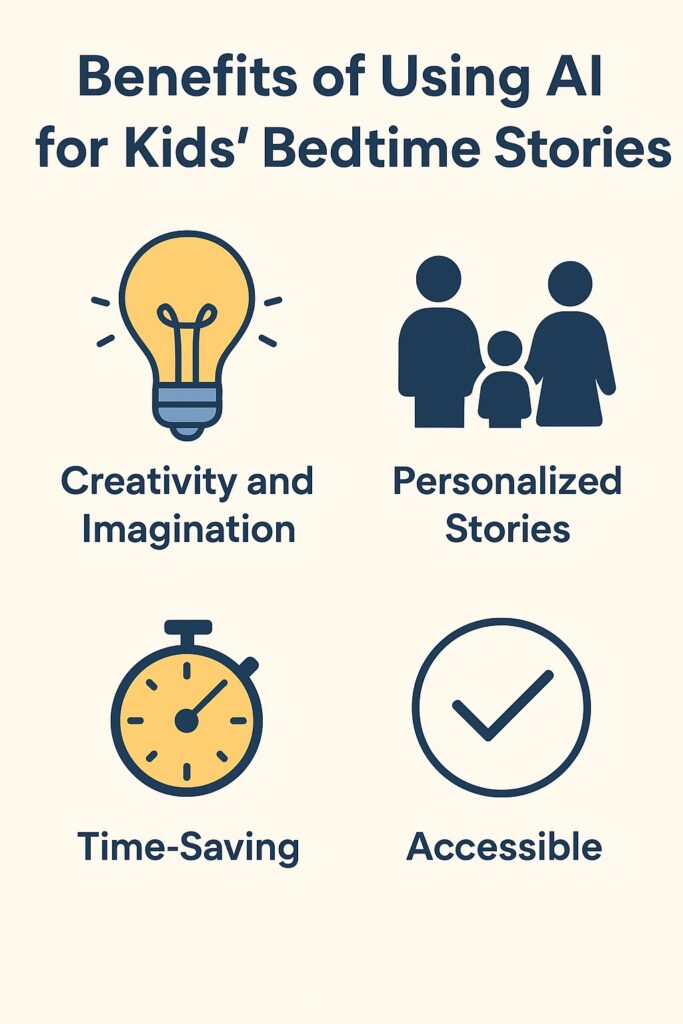
There are several powerful reasons to embrace AI for Writing Children’s Bedtime Stories. Beyond convenience, AI enhances creativity, personalization, and engagement in ways traditional storytelling can’t always match.
Here are a few key benefits:
-
Personalization at Scale: AI tools can include your child’s name, age, hobbies, and learning level to make each story feel tailor-made.
-
Endless Creativity: No more running out of ideas — AI can generate new characters, adventures, and settings every night.
-
Educational Value: You can ask AI to include moral lessons, vocabulary learning, or cultural insights in every story.
-
Time Saving: Parents who struggle with busy schedules can create bedtime stories in minutes.
-
Language Flexibility: AI tools support multiple languages, helping bilingual families teach kids both languages through stories.
Many parents find this approach life-changing. For instance, a teacher from Toronto shared her experience using AI-generated bedtime stories to help her ESL students improve reading comprehension and pronunciation. She found that students connected emotionally with stories that included familiar names or local settings.
To explore how AI is improving other daily tasks, check out How to Use AI for Home Budgeting on FindTechToday.
How AI for Children’s Bedtime Stories Actually Works
At the heart of Writing Children’s Bedtime Stories using AI lies natural language processing (NLP). AI systems like ChatGPT, Gemini, or BedtimeStory.ai are trained on millions of stories, myths, and books. They learn how narratives flow — from introducing characters to building conflict and creating emotional resolution.
When you provide a prompt like:
“Write a bedtime story about a brave rabbit who saves the moon from disappearing,”
The AI analyzes the structure of classic bedtime tales and generates a story with moral depth, gentle tone, and emotional rhythm. Some platforms even allow illustrations using AI image generators, turning your child’s imagination into a complete visual storybook.
However, it’s important to remember that AI is a creative partner, not a replacement for human storytelling. Adding your personal touch — such as your child’s nickname or a family memory — keeps the emotional warmth intact.
For technical readers interested in how AI models handle creative text generation, FindTechToday’s post on How to Use Gemini Advanced for Excel Data Analysis explains how pattern recognition and data training also apply to creative writing.
Practical Ways to Use AI for Writing Children’s Bedtime Stories
Using AI for Writing Children’s Bedtime Stories doesn’t mean you press a button and walk away. The best results come when parents and educators guide the AI with thoughtful prompts and add their human touch. Here’s how to make AI your creative partner — not a replacement.
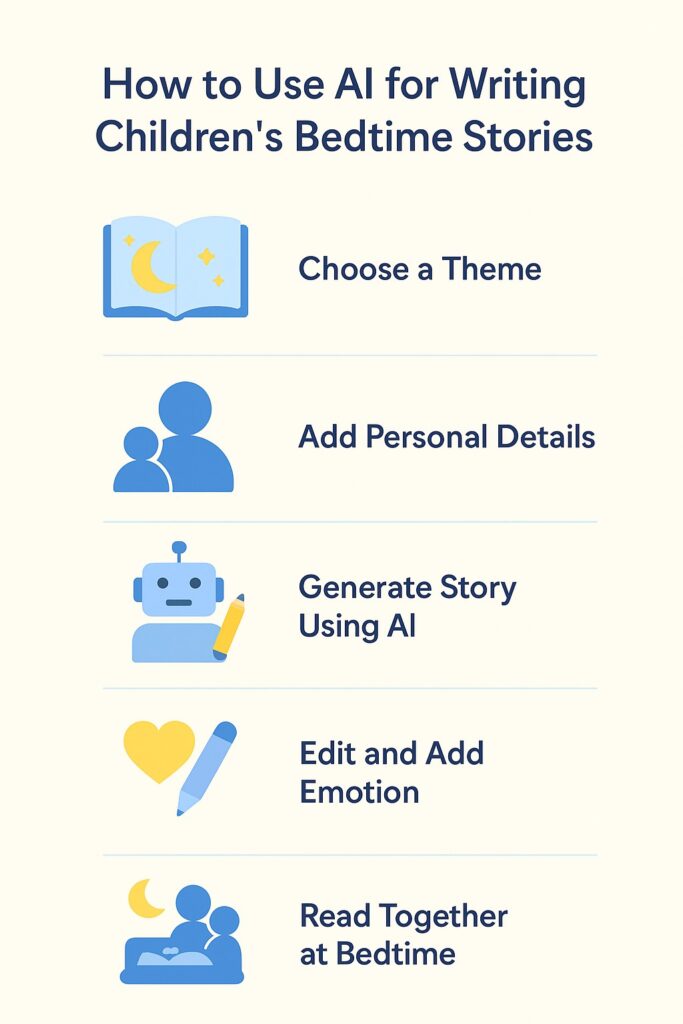
1. Start with a Clear Prompt
AI tools respond best to specific instructions. Instead of saying, “Write a story for my child,” try something like:
“Write a 500-word bedtime story for a 6-year-old about a shy dolphin who learns to be brave while saving her ocean friends.”
By setting a clear theme, character, and lesson, the AI tailors the story to your child’s needs. You can even request tone adjustments — for example, “gentle and magical” for bedtime or “funny and adventurous” for afternoon reading.
2. Personalize Every Story
One of the biggest advantages of using AI for Children’s Bedtime Stories is personalization. You can include:
-
Your child’s name and age
-
Their favorite animals or hobbies
-
Life events, like a first day of school or learning to ride a bike
-
A simple moral message like kindness or teamwork
This makes your child feel seen and involved in the story. A father from Sydney shared that when AI included his daughter’s pet parrot as a main character, she asked to read the story three nights in a row — proof that personalization builds emotional engagement.
3. Review and Refine the Story
AI-generated stories are a starting point. After generation, review and rewrite small parts to match your voice. Replace generic phrases with familiar ones, or add family details.
For instance, change “They had dinner together” to “They sat on the porch eating mom’s homemade spaghetti.”
Such details make the story feel authentic and filled with warmth.
If you’d like to explore how AI also helps in other personal areas, you might enjoy FindTechToday’s post on How to Protect Your Privacy in the Age of AI, which highlights responsible AI use for families.
Expert Insights: How Educators and Storytellers Use AI Creatively
Many experts now see AI for Writing Children’s Bedtime Stories as a tool that expands human imagination rather than limiting it. According to Dr. Maya Thompson, a child psychologist and education researcher at the University of Michigan, “AI-generated stories give parents an easy way to maintain a nightly storytelling habit while ensuring children still get positive emotional messages.”
She emphasizes, however, that human warmth and emotional narration matter more than the story’s source. Reading aloud, adding expressions, and involving children in storytelling discussions strengthen the bond between parent and child.
Rachel Lee, an early childhood educator, uses AI in her classroom to teach empathy. “I let children choose characters, and the AI builds a story around them. The kids love seeing their ideas come to life instantly — it motivates them to write and draw their own sequels,” she explained.
AI writers at BedtimeStory.ai also share that the most engaging stories come when adults co-create with the tool, not depend solely on it. They recommend revising endings, introducing moral dilemmas, or even asking the child how the story should continue — turning storytelling into an interactive, emotional experience.
Real-Life Examples of AI Creating Magical Moments
Many families worldwide are already using AI for Writing Children’s Bedtime Stories successfully. Let’s explore a few inspiring examples.
Case Study 1: The “Super Zara” Adventures
Zara, a 5-year-old from Dubai, loved superheroes but couldn’t relate to the typical comic book stories. Her mother used AI to create “Super Zara,” a bedtime series where the heroine used kindness instead of strength to solve problems.
After a few weeks, Zara began using phrases from her stories — like “Super Zara helps everyone!” — in daily life. Her parents noticed improved confidence and empathy.
Case Study 2: Classroom Collaboration in California
A primary school teacher, Mr. Alvarez, used AI to write weekly class stories featuring students as heroes. Each story taught a moral — teamwork, honesty, or patience.
The result? His students’ reading scores improved by 15% in one semester, and parents began using the same approach at home.
Case Study 3: A Family Tradition Reinvented
A grandparent in Scotland wanted to continue bedtime storytelling through video calls. Using AI, she created short fairy tales about “Granny Isla and the Talking Fox.” Her grandchildren eagerly awaited each new chapter.
For her, AI didn’t replace storytelling — it revived it across distance and generations.
Balancing Creativity and Ethics in AI Storytelling
While Writing Children’s Bedtime Stories using AI is exciting, it’s essential to maintain creative and ethical boundaries. Not all AI outputs are child-friendly, so parental review is critical.
Here’s how to stay responsible:
-
Always Preview Stories: Before reading aloud, check for age-appropriate language and themes.
-
Avoid Over-Reliance: Use AI as inspiration, not a substitute for parent-child connection.
-
Teach Digital Awareness: Explain to children that a computer helped write the story — it encourages curiosity about technology and honesty about content creation.
-
Ensure Diversity: AI should represent different cultures, abilities, and family types positively.
A 2025 study from Child Tech Review found that when parents actively participated in editing AI stories, children showed higher emotional engagement and comprehension scores. The conclusion? AI becomes most valuable when guided by empathy and human judgment.
How to Choose the Right AI Storytelling Tool
Not all AI platforms work the same way. If you’re new to AI for Children’s Bedtime Stories, here are key features to look for:
-
Safe and Family-Friendly Output: Tools should have built-in content filters.
-
Customization Options: Ability to add names, lessons, or character types.
-
Multi-Language Support: Great for bilingual or multicultural families.
-
Offline Access or Print Options: Helpful for bedtime routines away from screens.
-
Illustration Integration: Some AI tools generate matching artwork automatically.
Many parents prefer BedtimeStory.ai for its simplicity, but others use open models like ChatGPT or Gemini for full creative control. You can also explore guides like How to Fix ChatGPT Voice Mode Background Noise to improve storytelling experiences with AI voice narrators.
How to Add Emotion and Warmth to AI-Written Stories
Even though AI for Writing Children’s Bedtime Stories can generate magical plots, true emotional connection comes from you. The secret lies in adding warmth, rhythm, and personality to what AI produces.
Here’s how you can make each AI-generated story come alive:
1. Read with Expression
Children respond more to how a story is told than what it says. Use different voices for characters, pause for suspense, and smile while reading. The more expression you add, the more real the story feels.
2. Add Family Touches
Insert familiar details — your pet’s name, your neighborhood park, or favorite snacks. These small moments create emotional closeness that AI alone can’t replicate. It tells your child, “This story is for you.”
3. Encourage Imagination
After each story, ask questions like:
-
“What do you think happens next?”
-
“Would you like to be friends with this character?”
This builds creative thinking and keeps children emotionally invested in storytelling.
A child development expert, Dr. Samuel Rivera, notes, “When parents combine AI’s creativity with human storytelling warmth, they create a balance of innovation and emotional learning that benefits early childhood growth.”
That’s what makes AI storytelling so powerful — it supports connection, not just convenience.
The Future of AI in Children’s Storytelling
As technology advances, AI for Children’s Bedtime Stories will keep evolving. Future storytelling systems may recognize a child’s emotions through voice tone or facial expressions and adapt stories in real time. Imagine bedtime stories that respond to laughter, excitement, or curiosity — adjusting plots to keep your child engaged!
According to The Future of Education Journal (2025), AI-generated storytelling is projected to grow by 45% annually due to rising parental adoption and educational use. Many publishing companies are already experimenting with AI-assisted children’s books that mix personalized storytelling with beautiful, AI-generated illustrations.
Still, experts agree that AI will never replace the magic of human connection. Instead, it will continue to act as a creative partner that helps families tell more stories, not fewer.
As Dr. Rivera said, “AI is the pencil; the parent is still the artist.”
For more on how AI shapes everyday life, explore FindTechToday’s insightful post on How to Use AI for Vacation Planning.
Real Value: Why AI Storytelling Matters for Parents
Parents today are busy. Between work, school runs, and bedtime routines, finding time for fresh stories can be tough. That’s why Using AI for Writing Children’s Bedtime Stories is more than just a tech trend — it’s a way to bring back family storytelling traditions in a modern form.
The real value lies in how it:
-
Saves Time: Generate a bedtime story in under five minutes.
-
Boosts Creativity: Inspires children to invent their own stories.
-
Teaches Lessons: Lets you insert morals or emotional messages effortlessly.
-
Builds Connection: Turns bedtime into an interactive, shared moment.
These benefits make AI storytelling one of the most meaningful applications of technology for families — practical, educational, and deeply personal.
Challenges and How to Overcome Them
While the benefits are strong, it’s equally important to stay aware of challenges that come with Writing Children’s Bedtime Stories using AI:
1. Over-Automation
AI shouldn’t replace your storytelling. Balance automation with real emotion by reading together and discussing the story afterward.
2. Quality Control
AI might sometimes use repetitive ideas or outdated expressions. Always read and edit before sharing stories with children.
3. Privacy Concerns
Avoid sharing your child’s personal details online when using AI tools. Use reputable sites with data protection policies. For guidance, see How to Protect Your Privacy in the Age of AI.
With careful use, AI can be a safe, creative, and magical storytelling tool for every home.
The Human-AI Partnership in Storytelling
At its heart, AI for Writing Children’s Bedtime Stories is not about replacing parents or authors — it’s about empowering them. It helps people who may not consider themselves “writers” to create meaningful, personalized stories that make children smile.
When technology meets human love and imagination, storytelling becomes richer. A tired parent can still create wonder. A teacher can make every student feel special. A child can become both reader and creator.
That’s the true beauty of AI storytelling — it keeps imagination alive in every home.
Conclusion
The world of AI for Writing Children’s Bedtime Stories shows how technology can nurture creativity instead of replacing it. With the right balance of personalization, emotional warmth, and parental guidance, AI becomes a storytelling assistant that sparks joy, curiosity, and connection.
Children don’t remember every line of a story — they remember how it made them feel.
And when a parent uses AI wisely, bedtime becomes more than a routine — it becomes a journey filled with imagination, laughter, and love.
So tonight, try creating a story with AI. Add your voice, your warmth, and your child’s smile — and watch magic unfold.
FAQS
Is it safe to use AI tools for writing children's bedtime stories?
Yes, it’s safe as long as you use trusted AI platforms that filter inappropriate content. Always preview the story before reading it to your child to ensure it’s age-appropriate and aligned with your values.
Can AI really write stories as good as humans?
AI can create structured, creative stories quickly — but human touch gives them life. When parents add warmth, personal experiences, and emotional tone, AI-generated stories can feel just as magical as traditional ones.
How can I make AI-generated stories more engaging for my child?
Add familiar names, places, and moments. Use expressive reading, ask interactive questions, and involve your child in choosing characters or story endings. The more interactive you make it, the stronger the connection becomes.