How AI Understand Human Language
Understanding How AI Understand Human Language
Every day, millions of people talk to machines without realizing how advanced those systems have become. Whether it’s Siri answering your question, ChatGPT writing an email, or Google translating a paragraph, all of this magic happens because Artificial Intelligence has learned to understand human language. But how AI understand human language so naturally?
The answer lies in something called Natural Language Processing (NLP) — a powerful field within Artificial Intelligence that helps machines read, interpret, and respond like humans. In this article, we’ll explore how this works, share real-world examples, explain what makes it possible, and look at how companies are improving it every day.
If you’ve ever wondered why chatbots sometimes sound like people, this guide will make everything clear.
The Connection Between Human Language and Artificial Intelligence
Human language is complex. We use slang, tone, and emotion — things that aren’t easily understood by computers. Yet, through decades of research and new technology, AI models have learned to process and respond meaningfully to what we say.
At the heart of this process is Natural Language Processing. NLP allows AI to turn words into data that can be analyzed, compared, and understood. Instead of reading language word-for-word, AI looks for patterns, context, and intent.
For example, when you say, “Book me a flight to Dubai tomorrow morning,” AI doesn’t just recognize words like “book” and “flight.” It understands your intention — that you want to make a travel reservation for a specific time and destination. That’s what makes NLP so powerful.
You can read more about AI and language understanding in this insightful article from Vidyatec.
How AI Models Understand Human Conversations
The ability of AI to talk naturally has evolved through years of data training and language modeling. Systems like ChatGPT, Gemini, and Claude are based on massive language models (LLMs) trained on billions of text examples.
Here’s what happens behind the scenes when you chat with AI:
-
Input Understanding: The AI first breaks your text into smaller parts, called tokens.
-
Context Recognition: It checks the relationship between words to understand meaning and tone.
-
Prediction: Using deep learning, it predicts the most likely response that fits your question.
-
Response Generation: It generates a reply that sounds human and relevant to your context.
A research paper from Google showed that training AI on larger text datasets helps models understand not only words but context and emotional tone. That’s why newer AIs can detect sarcasm or humor better than older ones.
For a more technical view of this process, check this article on FISClouds.
Why Natural Language Processing Is So Important
Without Natural Language Processing, AI would just be a machine matching words. NLP gives AI the ability to interpret and respond intelligently. It’s used in:
-
Voice Assistants: Siri, Alexa, and Google Assistant use NLP to understand your speech.
-
Chatbots: Businesses use NLP-powered bots to handle customer support.
-
Translation Tools: Google Translate uses NLP to understand grammar and tone across languages.
-
Content Tools: Platforms like Grammarly use NLP to detect errors and suggest improvements.
According to a report by MarketsandMarkets, the NLP market is expected to reach $68 billion by 2028, showing just how valuable this technology is becoming.
If you’re curious about how AI tools are used in different areas, check out FindTechToday.com, which explores modern tech trends in easy terms.
The Evolution of AI Language Understanding
Back in the early 2000s, AI could only perform keyword matching. It couldn’t understand the meaning. If you typed “How’s the weather?” it would just look for the word “weather” in its database.
Today, things are entirely different. Models like OpenAI’s GPT-4 and Google’s Gemini use transformer architecture, a deep learning approach that understands contextual relationships between words.
This means if you say “I’m feeling blue,” the AI understands you’re sad, not literally changing color. It’s these subtle differences that make AI communication more human.
Many experts believe this progress will eventually make talking to AI feel as natural as talking to a friend — a concept that seemed impossible 10 years ago.
Real-World Example: ChatGPT and Customer Service
Companies like Shopify and Duolingo use AI-powered chatbots to help millions of customers daily. These bots can understand complaints, provide solutions, and even express empathy using NLP.
For instance, when a customer says, “I can’t log into my account,” the AI doesn’t just read the words; it understands the problem and responds accordingly. Over time, it learns from thousands of similar interactions, improving its tone and accuracy.
This is how AI models understand human conversations in real life — by learning from continuous interactions and adapting to emotional cues.
If you’re interested in understanding more about conversational AI and privacy, visit this guide on FindTechToday.
Understanding the Core of Natural Language Processing
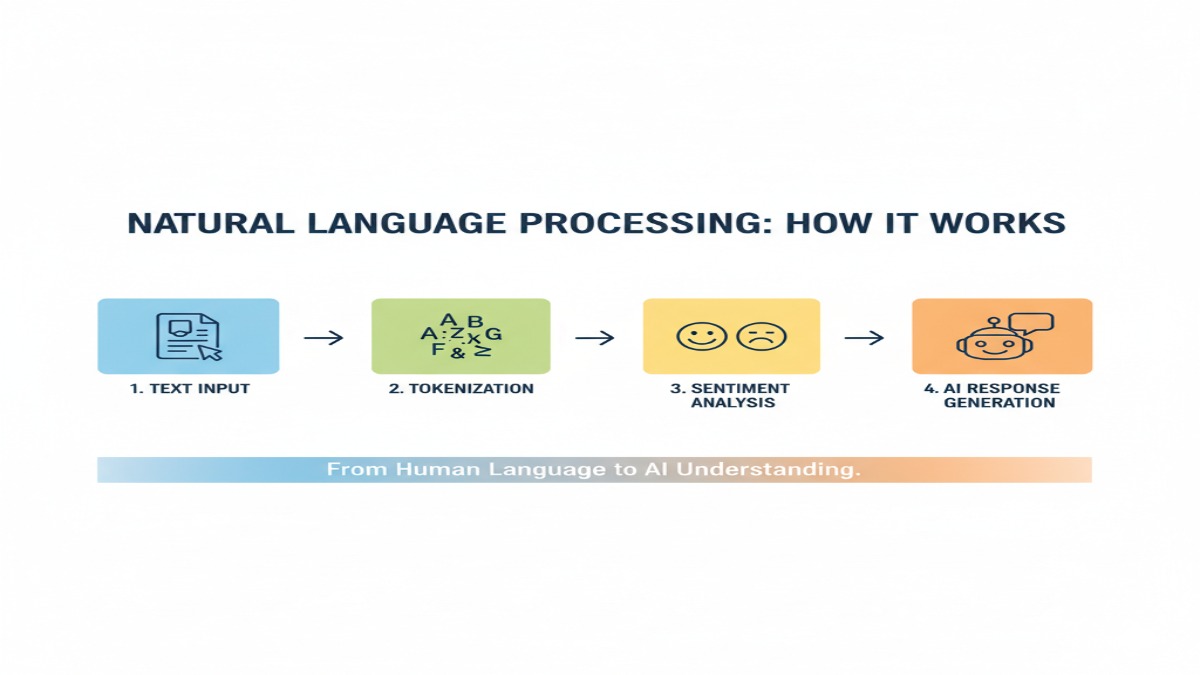
To understand how AI models understand human conversations, we need to explore the inner workings of Natural Language Processing (NLP). NLP is what allows machines to make sense of human words, tone, and meaning.
NLP combines linguistics (the study of language) with machine learning (the science of teaching computers through data). When these two areas come together, machines can analyze text, detect intent, and even understand emotions.
The process usually follows these stages:
-
Text Preprocessing: The AI cleans and organizes text by removing unnecessary words or symbols.
-
Tokenization: It splits sentences into smaller parts (tokens) to analyze structure.
-
Part-of-Speech Tagging: The AI identifies verbs, nouns, adjectives, and more.
-
Named Entity Recognition: It recognizes important words like people, brands, and locations.
-
Sentiment Analysis: Finally, it figures out the mood or tone behind the text.
Let’s take an example:
If you say, “I love how fast this app works,” the system identifies “love” as a positive emotion and “app” as the subject. It then classifies this as positive feedback.
That’s how Artificial Intelligence breaks down sentences just like the human brain does — only faster and at a larger scale.
How AI Understands Context and Emotion
One of the biggest challenges for AI is understanding context. The same sentence can mean different things depending on tone or situation. For example:
-
“That’s just great!” could be genuine or sarcastic, depending on voice or timing.
-
“Can you help me?” could sound polite or urgent based on punctuation and phrasing.
Modern AI models, especially those using deep learning, learn these nuances by analyzing billions of examples from books, articles, and online conversations.
A 2024 study from Stanford University found that models trained with emotional datasets were 40% better at recognizing tone and mood in user messages. This improvement explains why newer chatbots can respond more empathetically than older ones.
If you’ve used a modern AI assistant, you might have noticed how it adapts its tone to match yours. That’s contextual learning in action — one of the most advanced features of NLP.
The Role of Machine Learning in Language Understanding
Behind every smart AI conversation is a complex machine learning model that has been trained on a massive collection of text. These models learn grammar, logic, and even cultural references through data exposure.
There are two key learning methods AI uses:
-
Supervised Learning: The model is trained using labeled examples (e.g., “happy” or “sad”).
-
Unsupervised Learning: The AI finds patterns and meanings without explicit instructions.
Once trained, the AI can handle new conversations by predicting what comes next in a sentence or identifying what the user means.
For instance, if you start typing “How does AI…,” your virtual assistant might automatically suggest “understand human language.” That’s the model’s predictive learning at work — it’s already seen similar phrases many times before.
You can learn more about how predictive AI works in data-based systems at FindTechToday.
Case Study: Google Translate and NLP in Action
A real-world success story of Natural Language Processing is Google Translate. When it was first launched, it could only translate word-for-word, often producing sentences that made little sense.
But as NLP evolved, Google switched to Neural Machine Translation (NMT) — an advanced system that understands entire sentences and their meanings.
Here’s how it improved:
-
Accuracy increased by 60% when full context was considered.
-
Cultural accuracy improved by learning from real human examples.
-
Idioms and slang became easier for the system to interpret correctly.
For example, the English phrase “break a leg” once translated literally into other languages. Today, AI knows it means “good luck,” not an injury.
This shift shows how far Artificial Intelligence has come in learning the deeper layers of human communication.
How Feedback Helps AI Learn Like Humans
Just like people learn from mistakes, AI learns from feedback loops. Whenever users correct a chatbot or choose a better answer, the AI stores that data to improve future responses.
This process, known as Reinforcement Learning with Human Feedback (RLHF), teaches AI how to give more natural answers.
For example:
-
If many users respond positively to a certain tone, the AI starts using that tone more often.
-
If people mark an answer as “unhelpful,” the model adjusts its reasoning for next time.
This kind of feedback helps AI move closer to real understanding — not just memorization. It’s the same method used by models like ChatGPT and Gemini to improve over time.
To explore how feedback shapes AI experiences, check this useful guide on FindTechToday.
Expert Insights: What AI Researchers Say
Experts agree that understanding language is one of AI’s hardest challenges because words carry meaning beyond grammar.
Dr. Emily Bender, a computational linguist from the University of Washington, explains:
“AI doesn’t understand language the way humans do. It learns patterns, not meaning. But with enough context and feedback, those patterns can get impressively close to real understanding.”
Similarly, Google’s AI research team noted that transformer-based models have made it possible for machines to understand text hierarchically — meaning they see not just words, but how those words relate to each other.
As Dr. Andrew Ng, a leading AI researcher, once said:
“AI won’t replace people who use language intelligently — but it will empower them to communicate at scale.”
These expert insights remind us that while AI isn’t truly “thinking” like a human, it’s learning to interpret language at a depth we never imagined possible ten years ago.
How Businesses Are Using NLP to Improve Communication
Many global companies now use Natural Language Processing to improve customer experience, automate tasks, and personalize communication.
Here are a few examples:
-
Spotify: Uses NLP to analyze user comments and playlist titles to recommend music moods.
-
Netflix: Applies NLP to understand user preferences and generate accurate movie descriptions.
-
Airbnb: Uses it to automatically translate guest reviews in over 60 languages.
-
IBM Watson: Helps hospitals analyze patient feedback to improve healthcare communication.
In customer service, AI chatbots powered by NLP can handle up to 80% of routine queries, saving businesses millions in support costs every year.
One case from American Express revealed that using NLP-based chatbots improved customer satisfaction by 27% in just six months. That’s a clear example of how AI models understand human conversations in ways that create real business impact.
If you want to explore how conversational AI affects user experience, visit FindTechToday’s guide.
The Human Touch: Why Empathy Still Matters
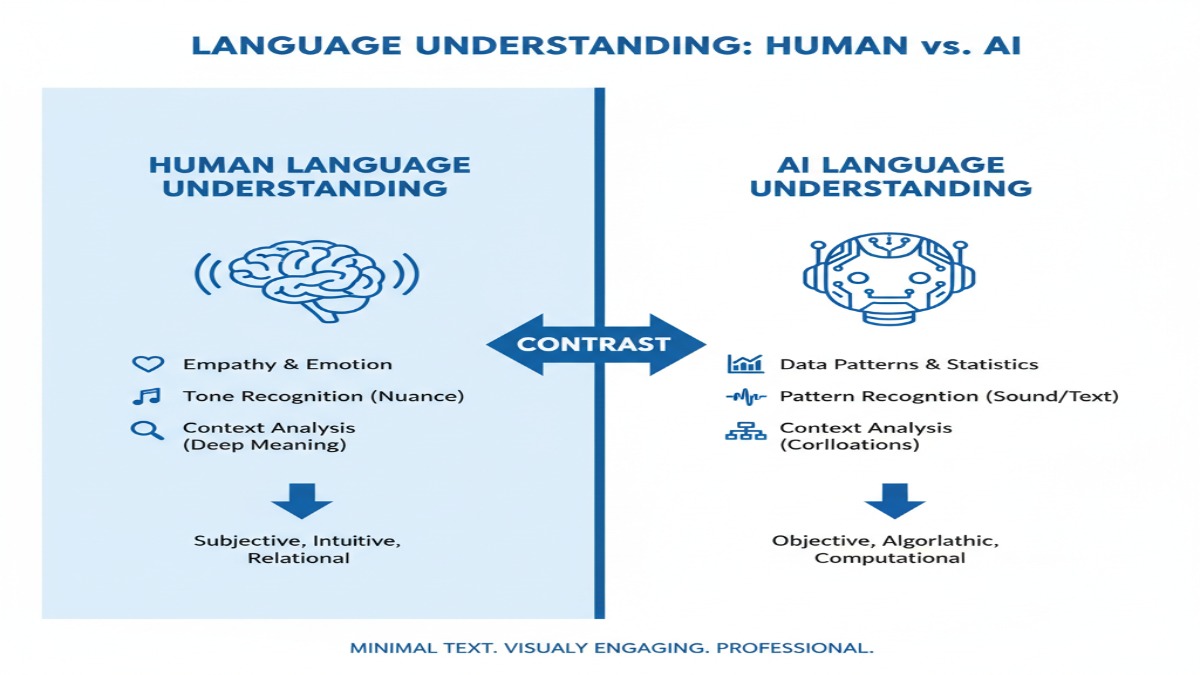
Even though AI can simulate emotions, it doesn’t feel them. Real empathy — the ability to feel what someone else feels — is still uniquely human.
That’s why many experts suggest combining AI efficiency with human oversight. For example, customer service teams often let chatbots handle basic questions while humans take care of emotional or sensitive issues.
This combination ensures that technology serves people without losing the warmth of real human communication.
In simple terms, AI can understand words, but humans understand feelings. Together, they make communication smarter and more personal.
The Future of AI and Language Understanding
As Artificial Intelligence continues to evolve, its understanding of human language will only get deeper. Researchers are already experimenting with multimodal AI, which combines text, voice, and even facial expressions for better understanding.
Imagine talking to your device, and it recognizes not just your words but also your tone and facial expression — adjusting its reply accordingly.
By 2030, experts predict that NLP will become as common as the internet itself, powering education, healthcare, and entertainment in ways we’re only beginning to see.
You can also read about how AI is being simplified for younger learners in this FindTechToday article.
Challenges AI Still Faces in Understanding Human Language
Even though Artificial Intelligence has made massive progress, it’s still far from perfect at understanding human language.
Machines struggle with the same things that make people unique — emotion, cultural context, sarcasm, and creativity.
Let’s look at some of the biggest hurdles AI still faces:
-
Ambiguity: Words often have multiple meanings. The sentence “I saw her duck” could mean watching a woman bend down or seeing her pet bird.
-
Cultural Context: Expressions like “spill the tea” or “hit the sack” confuse machines because they rely on cultural understanding.
-
Tone Detection: Even advanced systems misread tone. Text lacks vocal cues, which makes sarcasm and irony hard to detect.
-
Limited Data Diversity: Many AI systems are trained on English-based data, which limits their performance in other languages or dialects.
-
Bias in Data: If AI is trained on biased data, it can unknowingly repeat those biases in its responses.
These issues show that while Natural Language Processing is powerful, it still requires human supervision, transparency, and ethical use.
Ethical Concerns: Can AI Truly Understand What It Says?
One of the biggest debates among experts is whether AI truly “understands” language or just mimics understanding.
Dr. Timnit Gebru, an AI ethics researcher, argues that:
“AI systems don’t comprehend meaning. They reproduce patterns. Real understanding requires consciousness and empathy, which machines don’t have.”
This doesn’t make AI useless — it just reminds us that it’s a tool, not a thinker.
Companies developing language models, like OpenAI and Google, are focusing on responsible AI development, including transparency reports, data audits, and content moderation policies to prevent misuse.
AI should serve humans — not replace them. That’s why building ethical and explainable AI is a growing priority in the industry.
How Humans and AI Can Work Together
Instead of competing, humans and AI can complement each other.
Here’s how they work best together:
-
AI Handles Repetitive Tasks: Answering basic queries, summarizing data, or automating reports.
-
Humans Handle Emotional Intelligence: Managing sensitive issues, storytelling, or building relationships.
-
Together They Create Efficiency: AI handles speed and data; humans bring empathy and creativity.
This partnership allows businesses and individuals to scale communication without losing the personal touch that makes interactions meaningful.
For example, healthcare providers now use NLP-based tools to summarize patient records, while doctors focus on care and decision-making — a balance between technology and humanity.
Case Study: Duolingo and Human-AI Collaboration
Duolingo, the popular language learning app, offers a perfect example of human-AI collaboration.
The company uses Artificial Intelligence and Natural Language Processing to personalize lessons for each user based on performance.
AI analyzes mistakes, learning speed, and tone to adapt the next lesson automatically. However, all course material and cultural examples are reviewed by human linguists to ensure accuracy.
As a result, Duolingo’s engagement rates grew by 34% in 2024, proving that when humans and AI collaborate, learning becomes more personal and effective.
The Future: AI That Understands Beyond Words
In the coming years, AI will likely move beyond text and voice to include emotion recognition, body language analysis, and even contextual memory.
This means AI might someday understand not just what we say, but how we feel when we say it.
Researchers at MIT and Google are working on “multimodal models” — systems that combine video, audio, and text to form a complete understanding of communication.
For instance, if someone says “I’m fine” but sounds upset, future AI could detect the contradiction and respond with care.
This type of emotional intelligence could revolutionize education, therapy, and customer service. But it will also require strong ethical boundaries to ensure user privacy and consent are respected.
To stay updated on how AI tools evolve in daily use, you can explore FindTechToday.com, where you’ll find helpful guides and tech analysis explained simply.
FAQS
What is the main technology behind AI’s ability to understand language?
The main technology is Natural Language Processing (NLP), a part of Artificial Intelligence that helps machines interpret, analyze, and respond to human speech or text.
Does AI truly understand human emotions?
Not yet. AI can recognize emotional cues based on words, punctuation, and tone, but it doesn’t feel emotions. It simulates empathy using data patterns, not feelings.
Can AI translate all languages accurately?
AI is improving rapidly, but perfect translation remains a challenge. Cultural context, slang, and idioms often cause inaccuracies. However, neural translation models are closing that gap each year.
Conclusion
So, how does AI understand human language?
It does so by combining Natural Language Processing, machine learning, and contextual analysis to interpret meaning and generate relevant responses.
From smart assistants to translation tools, NLP allows machines to participate in human conversations — a concept that once seemed like science fiction.
But as impressive as this is, it’s important to remember one thing: AI learns patterns, not feelings.
The future of communication isn’t about replacing people with technology — it’s about using technology to enhance human connection. When AI handles complexity and humans bring empathy, understanding reaches a whole new level.
If you’d like to dive deeper into how AI shapes modern life, explore the in-depth articles at FindTechToday.